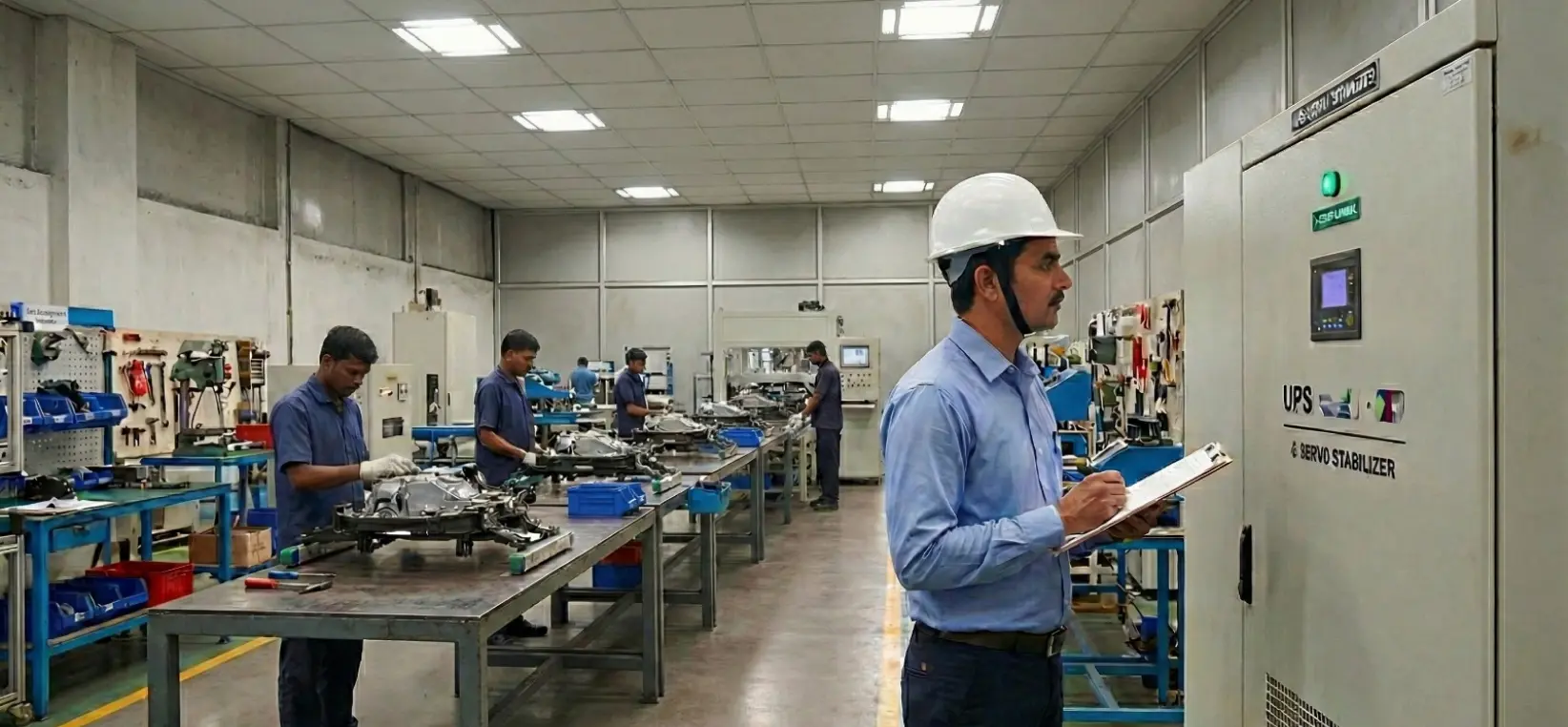
Power quality issues in industrial installations are rarely caused by a single failure. More often, they arise from a series of small decisions, assumptions made during design, shortcuts taken during installation, or oversights during expansion.
Across industrial facilities worldwide, certain power quality mistakes appear repeatedly. Understanding these patterns is the first step toward building more reliable systems.
Mistake 1: Assuming the grid will remain stable
One of the most common assumptions is that grid power will be sufficiently stable for industrial equipment. While grids are designed to meet regulatory standards, they are not optimized for sensitive industrial loads.
Voltage fluctuations, phase imbalance, and transient disturbances are normal characteristics of real-world supply, especially in areas with mixed residential and industrial demand.
Avoidance strategy: Design internal power systems to tolerate instability rather than assuming ideal supply conditions.
Mistake 2: Undersizing voltage stabilization equipment
Stabilizers are often selected based on nominal load ratings, without accounting for starting currents, future expansion, or dynamic behavior.
Undersized equipment may function initially but struggle under peak conditions, leading to frequent stress and reduced lifespan.
Avoidance strategy: Consider worst-case scenarios, not just average loads. Conservative sizing improves reliability and flexibility.
Mistake 3: Ignoring phase imbalance
Phase imbalance is frequently underestimated, especially in facilities with a mix of single-phase and three-phase loads.
Over time, imbalance leads to:
- Motor overheating
- Reduced efficiency
- Increased losses
- Premature equipment failure
Avoidance strategy: Monitor and actively correct imbalance rather than relying solely on distribution practices.
Mistake 4: Treating earthing as an afterthought
Earthing is often addressed late in the project lifecycle, sometimes as a compliance requirement rather than a functional design element.
Poor earthing amplifies the effects of voltage disturbances and compromises protective systems.
Avoidance strategy: Design earthing as a foundational element of the power system, not an accessory.
Mistake 5: Mixing sensitive and noisy loads
Heavy loads such as welders, compressors, and large motors can introduce disturbances that affect sensitive equipment like PLCs, drives, and instrumentation.
Without proper segregation or conditioning, these interactions cause intermittent and difficult-to-diagnose problems.
Avoidance strategy: Isolate critical loads through dedicated conditioning and thoughtful distribution design.
Mistake 6: Over-reliance on reactive protection
Protection devices such as MCBs and MCCBs are essential, but they act after a fault occurs.
Many facilities rely heavily on protection while neglecting prevention, leading to repeated trips and resets rather than stable operation.
Avoidance strategy: Combine protection with proactive correction through stabilization and conditioning.
Mistake 7: Expanding without reassessing power infrastructure
As facilities grow, power systems are often extended incrementally without reassessing original design assumptions.
What worked for one production line may be inadequate for three.
Avoidance strategy: Reevaluate power quality requirements whenever capacity or process complexity increases.
A systematic approach to prevention
Facilities that avoid these mistakes typically adopt a systems-level perspective. Power quality is treated as an integrated design discipline rather than a collection of components.
This approach results in fewer surprises, better performance, and more predictable operations.