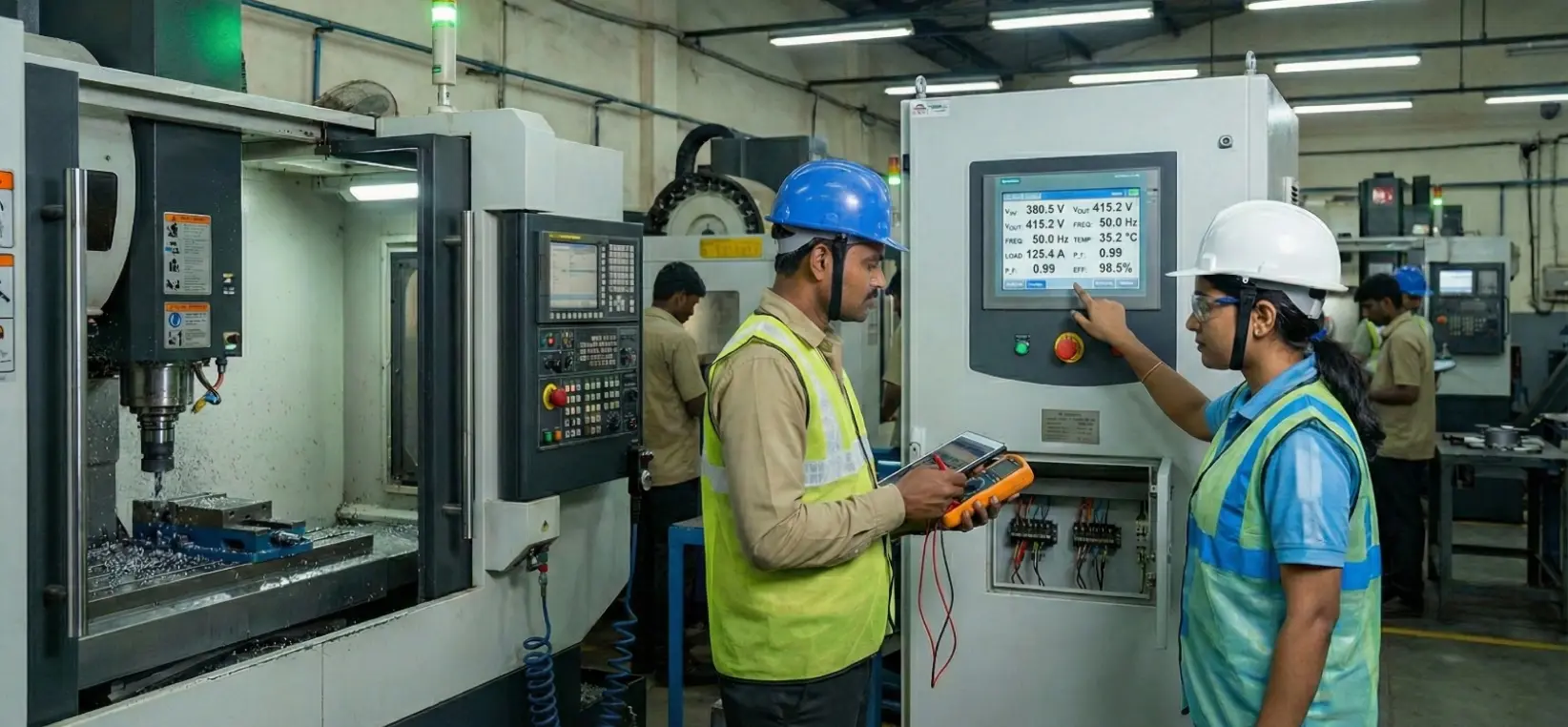
In industrial environments, voltage fluctuations are often discussed in terms of compliance, whether supply remains within acceptable limits. What is discussed far less frequently, yet has a far greater impact on equipment longevity, is how quickly voltage deviations are corrected.
As industrial processes become faster, more automated, and more electronically controlled, response time has emerged as a defining factor in power system reliability.
Voltage deviations are rarely slow
In real-world installations, voltage disturbances are not gradual events. They occur suddenly during motor starts, load shedding, welding operations, grid switching, or upstream faults. These deviations may last milliseconds or seconds, but their effect on equipment can be disproportionate.
While many systems are designed to tolerate a degree of variation, repeated exposure to short-duration voltage swings accelerates wear at the component level.
Why speed matters more than magnitude
A common misconception is that only large voltage deviations cause damage. In practice, frequent small deviations corrected too slowly often cause more harm than occasional large events.
Power electronic components such as IGBTs, rectifiers, capacitors, and control power supplies are especially sensitive to rapid input changes. Even if average voltage remains within limits, transient exposure stresses components repeatedly.
Fast voltage correction prevents these disturbances from ever reaching the load. Slow correction allows them to pass through, briefly, but often enough to matter.
Impact on motors and drives
Electric motors and variable frequency drives form the backbone of modern industry. Voltage instability affects them in several ways:
- Increased current draw during undervoltage
- Excessive heating during overvoltage
- Torque fluctuations impacting mechanical systems
- Increased stress on drive electronics
When voltage correction lags behind the disturbance, motors experience repeated stress cycles. Over time, insulation degradation, bearing wear, and electronic failures become more likely.
Automation systems and process stability
In automated processes, consistency is everything. PLCs, sensors, servo drives, and control networks rely on stable power to maintain synchronization.
Slow voltage correction can result in:
- PLC resets or communication faults
- Erratic sensor readings
- Control loop instability
- Process interruptions that are difficult to trace
These issues are often misdiagnosed as software or communication problems, when the root cause lies in power quality.
Mechanical correction vs electronic response
Traditional electromechanical voltage correction methods rely on physical movement, with motors adjusting transformer taps or variacs. While effective for slow, predictable variations, they are inherently limited by mechanical response time.
Solid-state correction systems, by contrast, respond electronically. With no moving parts, they can detect and correct voltage deviations almost instantaneously.
This difference is not incremental. It fundamentally changes how disturbances are handled.
Cumulative effects on equipment life
Equipment failure is rarely caused by a single event. More often, it is the result of cumulative stress applied over thousands of operating hours.
Fast voltage correction reduces:
- Thermal cycling in components
- Electrical stress on insulation
- Mechanical strain caused by torque variations
- Nuisance tripping and restart cycles
Over the life of the equipment, this translates directly into longer service intervals, fewer unexpected failures, and more predictable maintenance planning.
The hidden cost of slow correction
From a cost perspective, slow voltage correction is deceptive. Equipment may continue operating, masking the underlying issue. Failures occur months or years later, often outside warranty periods, making root-cause analysis difficult.
Organizations focused on long-term asset performance increasingly recognize that response speed is not a specification detail. It is a reliability parameter.
Designing for modern industrial realities
Modern industrial power systems are designed with the assumption that disturbances will occur. The question is not whether voltage will fluctuate, but whether the system can respond fast enough to prevent those fluctuations from affecting critical loads.
Facilities that prioritize fast voltage correction tend to experience:
- Higher uptime
- Better product quality
- Lower maintenance burden
- Improved confidence in automation systems
Looking forward
As industrial processes continue to increase in speed and complexity, tolerance for power instability will continue to shrink. Voltage correction speed will become an even more critical design consideration, not just for stabilizers, but for the entire power infrastructure.
The most resilient systems are those designed with an understanding that milliseconds matter.