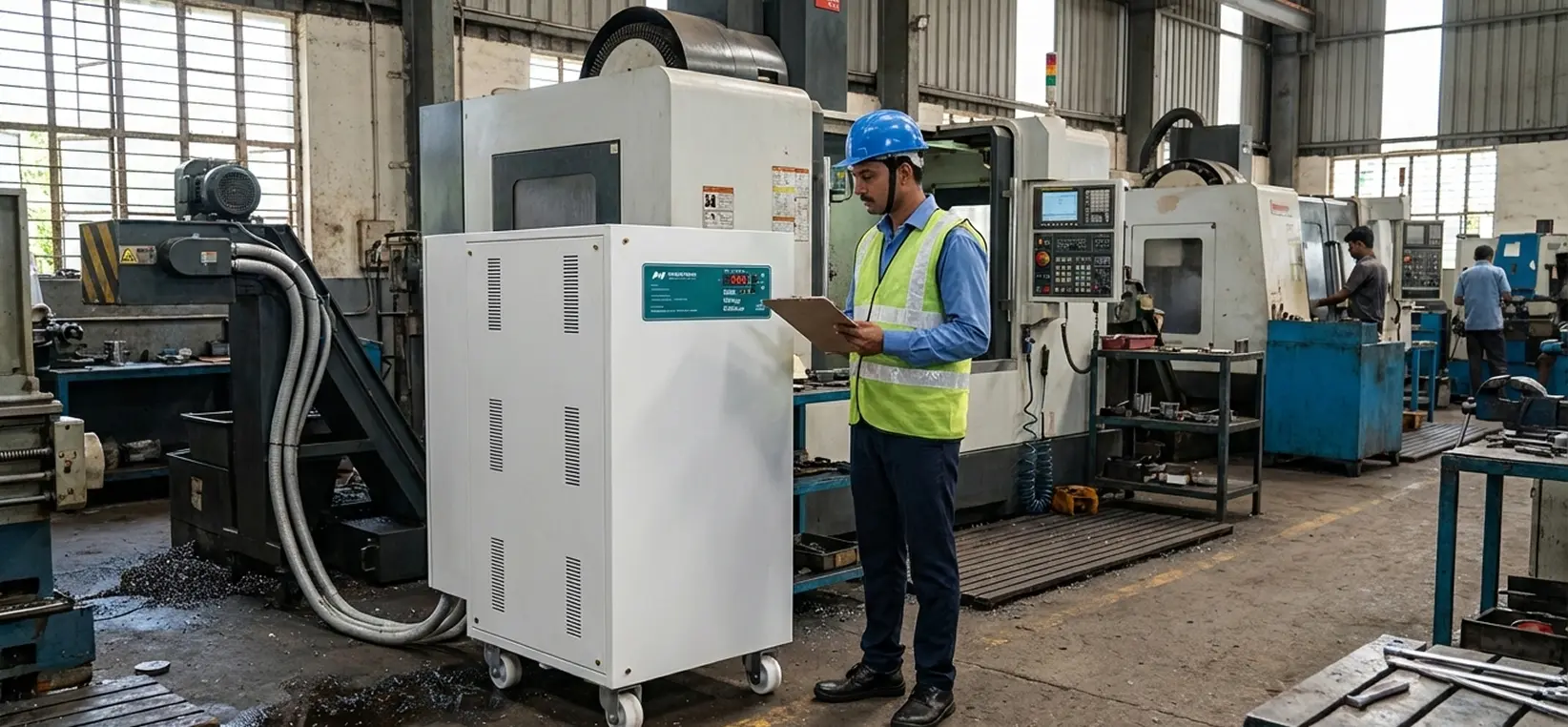
Voltage stabilizers have long been a critical component of industrial power systems. However, as industrial loads and operating environments have evolved, so too have stabilization technologies. Today, the choice between static and servo voltage stabilizers is no longer a matter of preference. It is a matter of application suitability.
Understanding the fundamental differences between these technologies is essential for making informed, long-term decisions.
A brief overview of stabilization principles
At their core, voltage stabilizers are designed to maintain a consistent output voltage despite variations in input supply. The difference lies in how this correction is achieved.
Servo stabilizers rely on electromechanical movement to adjust voltage levels, while static stabilizers use solid-state electronics to achieve correction without moving parts.
Both technologies have their place, but their performance characteristics differ significantly.
Servo stabilizers: strengths and limitations
Servo stabilizers have been widely used for decades and remain suitable for certain applications. Their design is relatively simple, and they perform adequately in environments where voltage changes are gradual and predictable.
However, servo systems inherently involve mechanical components such as motors, gears, and carbon brushes. These introduce limitations:
- Slower response times
- Mechanical wear over time
- Regular maintenance requirements
- Reduced performance under rapid voltage fluctuations
In applications with steady loads and moderate correction needs, servo stabilizers can still perform reliably.
Static stabilizers: a modern approach
Static voltage stabilizers represent a shift toward solid-state power control. By eliminating mechanical movement, they enable much faster response and higher precision.
Key characteristics of static stabilizers include:
- Instantaneous voltage correction
- High correction speeds, often tens of thousands of volts per second
- No mechanical wear
- Minimal maintenance
- Consistent performance under dynamic loads
These attributes make static stabilizers particularly suitable for modern industrial environments with automation, variable loads, and sensitive electronics.
Response time: why it matters
One of the most critical differentiators between static and servo stabilizers is response time. In many industrial processes, voltage fluctuations occur faster than mechanical systems can respond.
Static stabilizers correct these deviations in real time, preventing downstream equipment from ever experiencing the disturbance. Servo systems, by contrast, may allow transient deviations to pass through before correction occurs.
For equipment such as CNC machines, robotics, printing presses, and PLC-controlled systems, this difference is often decisive.
Maintenance and lifecycle considerations
From a lifecycle perspective, maintenance plays a significant role in total cost of ownership. Servo stabilizers require periodic inspection, brush replacement, and mechanical adjustments. Over time, these interventions add cost and downtime.
Static stabilizers, with no moving parts, significantly reduce maintenance requirements. While initial investment may be higher, lifecycle costs are often lower, particularly in continuous-operation environments.
Application-based selection
The choice between static and servo stabilization should always be application-driven. Factors to consider include:
- Nature of load, whether static or dynamic
- Sensitivity of connected equipment
- Frequency and magnitude of voltage fluctuations
- Maintenance philosophy
- Operational criticality
In facilities where uptime, precision, and automation are priorities, static stabilization is increasingly the preferred choice. In simpler or less demanding environments, servo systems may still be appropriate.
Avoiding oversimplification
A common mistake is to frame the discussion as static is better than servo. In reality, the correct approach is contextual. Globally experienced manufacturers recognize that different technologies serve different needs, and selection should be guided by engineering analysis, not marketing claims.
Integrating stabilizers into the broader power system
Voltage stabilizers do not operate in isolation. Their performance depends on upstream and downstream conditions, including transformers, earthing systems, and load characteristics.
Proper integration, sizing, and coordination with other power equipment are essential for achieving the desired outcome. This is where application knowledge and field experience play a critical role.
Final thoughts
As industrial power requirements continue to evolve, the role of voltage stabilization becomes increasingly strategic. The decision between static and servo technology should be based on long-term performance, reliability, and suitability, not short-term cost considerations.
Organizations that approach this decision with an engineering mindset are far more likely to achieve stable operations and predictable outcomes over the life of their equipment.