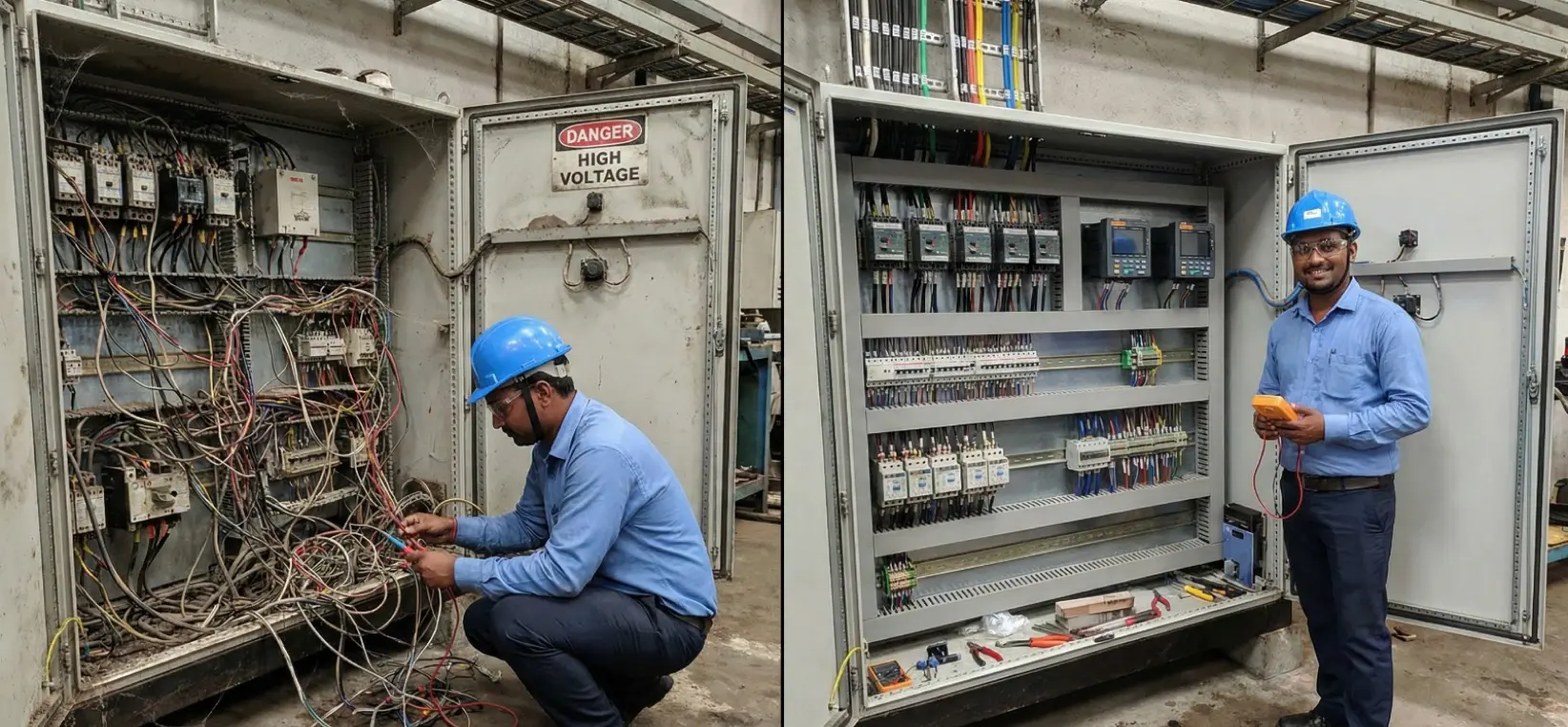
Industrial power systems are rarely installed under ideal conditions. In practice, they operate in environments shaped by heavy loads, unpredictable grid behavior, climatic stress, and human intervention. Designing for such conditions requires a mindset that goes beyond nominal specifications.
Globally experienced manufacturers approach power system design with one assumption: real-world electrical environments are harsh, dynamic, and unforgiving.
What defines a harsh electrical environment
Harshness in electrical terms is not limited to extreme voltage levels. It encompasses a combination of factors:
- Wide voltage swings
- Phase imbalance
- Frequent load changes
- Poor power factor
- Inconsistent earthing
- High ambient temperatures
- Exposure to surges and lightning
Any one of these can challenge equipment reliability. In combination, they demand deliberate engineering decisions.
Why laboratory conditions are misleading
Equipment specifications are often derived from controlled laboratory tests. While these tests are necessary, they do not fully represent field conditions.
In real installations:
- Load profiles change unpredictably
- Earthing quality varies widely
- Environmental conditions fluctuate
- Maintenance practices differ
Designing solely to laboratory benchmarks often results in systems that perform well on paper but struggle in the field.
The importance of design margins
One hallmark of robust industrial power systems is the use of appropriate design margins. These margins account for uncertainty, including unknown load behavior, upstream disturbances, and environmental stress.
Design margins are not inefficiencies. They are risk management tools. They ensure that equipment operates well within safe limits under normal conditions and can tolerate abnormal ones without failure.
Managing voltage imbalance
Phase imbalance is one of the most common yet underestimated issues in industrial installations. Uneven loading, single-phase equipment, and distribution asymmetry all contribute to imbalance.
If left unaddressed, imbalance leads to:
- Overheating in motors and transformers
- Reduced efficiency
- Premature failure of rotating equipment
Effective power system design incorporates active correction mechanisms rather than relying solely on upstream distribution quality.
Earthing: the foundation often overlooked
Earthing is frequently treated as an installation detail rather than a design consideration. In harsh environments, poor earthing amplifies the impact of voltage disturbances, surges, and transient faults.
Well-designed power systems assume imperfect earthing and incorporate protection and correction strategies accordingly. This approach reflects field reality rather than ideal assumptions.
Thermal considerations in harsh environments
Electrical performance is closely tied to temperature. High ambient conditions reduce component life, increase losses, and narrow operating margins.
Designing for harsh environments means:
- Selecting components rated for elevated temperatures
- Ensuring adequate thermal management
- Avoiding operation near maximum limits
Thermal resilience is often the difference between theoretical reliability and real-world performance.
Integration of protection and correction
In demanding environments, protection and correction cannot be treated as separate functions. Overvoltage protection, surge suppression, voltage stabilization, and backup power must work in coordination.
Fragmented design, where each element operates independently, often leads to unintended interactions and gaps in protection.
An integrated approach ensures that disturbances are addressed systematically rather than symptomatically.
Field feedback as a design input
One of the most valuable inputs to power system design is field feedback. Installations across different industries and regions reveal patterns that no laboratory test can replicate.
Organizations with long-term field exposure continuously refine their designs based on observed failure modes, environmental stress factors, and operational challenges.
This iterative approach is characteristic of manufacturers with deep deployment experience.
Designing for maintainability
In harsh environments, maintenance access and serviceability become critical. Designs that require frequent intervention are poorly suited to such conditions.
Power systems designed for reliability emphasize:
- Minimal moving parts
- Clear diagnostics
- Long service intervals
- Predictable aging behavior
This reduces dependence on perfect maintenance practices, which rarely exist in the real world.
A long-term perspective
Ultimately, designing for harsh electrical environments is about acknowledging reality. Industrial power systems must function not just when conditions are good, but when they are at their worst.
Facilities that adopt this mindset experience fewer surprises, more predictable operations, and greater confidence in their infrastructure.